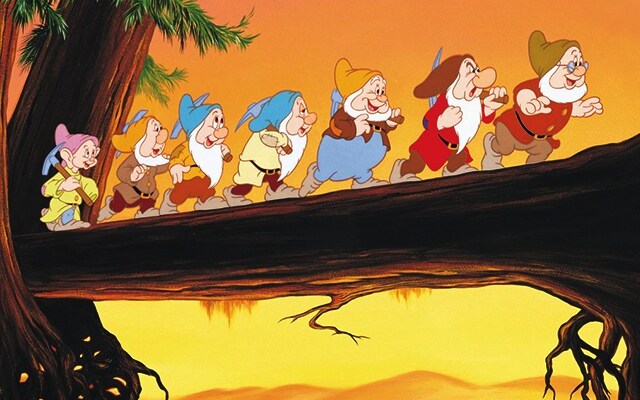
Heigh ho, heigh ho, it’s off to work I go.
I was sure that was what the Seven Dwarfs sang. You too? Well maybe not. At a Quiz Night last weekend, the host assured us that actually it was ‘Heigh ho, Heigh ho, it’s home from work we go.’ And it turns out she was 100% correct and I’d been singing it incorrectly for years.
It’s home from work we go.
During the same weekend, I was in conversation with a guy and we were musing about the impact of work on the time we spent with our children. He spoke of the regular separation from his family due to working away for periods of each week. And yet each time he came home, after days or weeks away, his children would greet him the same way. They run to the door and he’s overwhelmed by hugs and affection. Welcome home!
It’s home from work I go.
Earlier that day, I recorded our latest Bald Headteacher podcast (https://youtu.be/KmF-JT5XNIk?si=IrRTEn7iWSI1HshN), where Dr Tom Gillham and I discussed the increasing absence rate in the education and NHS workforce, plagued by stress, anxiety and desperation, or at least that’s what the statistics show.
So if the Seven Dwarfs were singing nowadays, I wonder if they would actually be singing,
Heigh ho, heigh ho, it’s home from work I stay?
Because this is a trend that merits attention.
Take the recently released TES Teacher Wellbeing Report 2026, It states that the profession is moving from a state of high-pressure endurance to one of burnout. The fact that more than half of teachers (57%) report negative wellbeing indicates that the coping mechanisms previously used to navigate the pressures of teaching are now failing under the weight of permanent stress. One teacher described teaching as an “impossible job to do well”, with a growing sense that while other industries are able to protect their workforces from abuse, teachers are simply “expected to take it”.
I would bet my life that this just scratches the surface.
This research adds to the multiple anecdotal stories I have heard over the last few years. The level of moral injury being felt by school staff is leading to more and more absence from school. What has also been telling is the length of some absences; we are talking months rather than weeks in some cases.
It seems that rather than going home, full of positivity, to be met by happy children showering kisses on us, we are arriving home in a terrible state, exhausted and demoralised.
And yet our top-level conversations, discussions, tweets and press releases prefer to avoid the subject, as something only a very small minority of people suffer from. Or we divert attention, as in the disgust at the latest resident doctors’ strike. How could they withdraw their labour after such a huge pay increase? But, as Alice Thomson argues in the Times this week, it is less to do about money and more about conditions.
It’s the same in education. We are ignoring the big issue – that the conditions in which we do our work are becoming more and more impossible. The moral injury incurred on those working in health and education (and in prisons, and police, and social work etc etc) is what is behind the rise in absence from work. Pay is a secondary issue.
Look at the famous video of the Seven Dwarfs again. They come home from work singing, happy, fulfilled. There is solidarity, a common purpose. They have hope. Yes, of course it’s fiction, Disney fiction, glossed and touched up I admit, but perhaps there is a lesson for us all here.
To reverse this trend of absence from work, we must reclaim the dignity of work, the purpose of work and the gratitude and shared endeavour that work dispels. We must create a set of different conditions for people to work in, where their efforts are validated and respected. Of course money helps, but money alone will not solve this. Conditions are crucial.
Too many parts of our lives are becoming transactional. Fulfil the job description? Tick off the person specification? Complete the requested competencies? OK, we’ll pay you then and you will pass your appraisal (or even worse your performance management review). Ironically, in an employment arena where competition is coming for us in the form of AI, we are more and more treating human employees as if they were computers or AI bots.
This is not what human beings want. Instead, they want to be part of something bigger and better, they want to share in a project, a joint ambition, to the there when things go well and to stand in solidarity when things go pear-shaped, as they often do in our turbulent world.
Work also provides an identity. When working in a supportive and productive environment, the individual finds fulfilment and mental strength. Being away from work, as so many are now finding, knaws away at that same identity and leads to dissatisfaction and ennui.
For us to exclaim joyfully ‘it’s home from work I go’, we have to address the increasingly upsetting conditions experienced by employees, and we need better leaders to guide them, steer them and validate them.
As with most things, this is going to come down to leadership. At present, too many leaders avoid addressing this, hiding behind policies and procedures, afraid to create the dynamic environments that allow people to flourish. Without this leadership, I worry that things will only get worse and our economy, our families and our schools will suffer.
In the end, the Seven Dwarves needed the Prince to help them revive Snow White. We need something similarly special to revive the culture of work.
 Bald Headteacher