Last weekend, a good friend of mine was in a store in town when she was accosted by a group of young teenagers. They proceeded to provoke her with abuse and threats, poking her and standing in her way. One of them then said, ‘I’m autistic you know!’, the inference being that ‘you say anything back to me and I will use this against you.’
My friend showed remarkable patience and went to see the store manager, who shrugged her shoulders and said, ‘We don’t have a security guard because the last one was beaten up by another group of kids last week.’ But that’s another story.
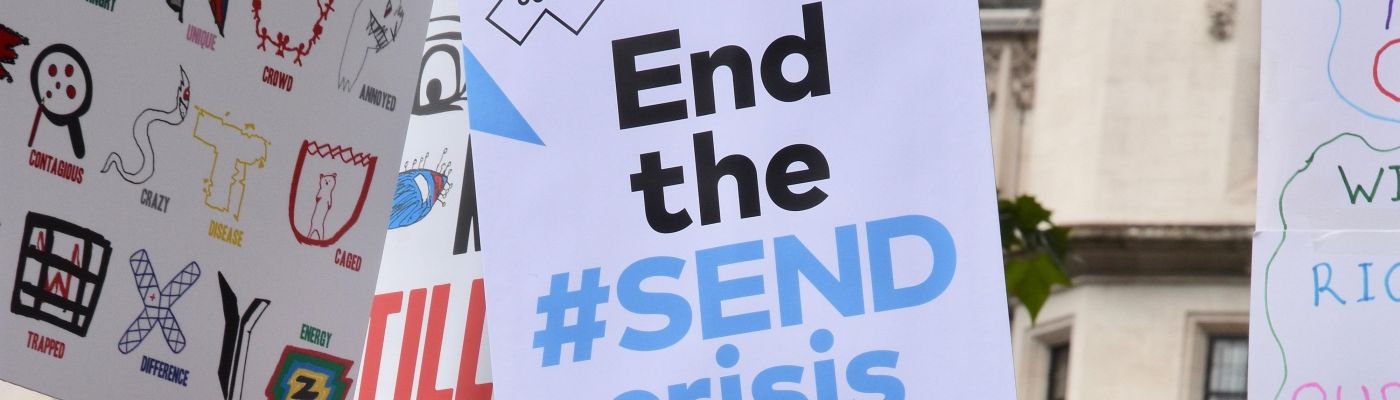
My story revolves around this autism comment, and what I perceive as being a weaponising, perhaps even a trivialising of disability at a time when SEND is becoming quite a toxic subject in our society. It is both a sign of our success as a society that it is so much more mainstream, yet also a sign of our weakness as a society where it has become an unfortunate proxy for less virtuous practices such as the incident described above.
My brother Richard, who died back in 2009, was profoundly disabled. He brought worry and stress to my parents, but ultimately such joy in his short life, to all those who come into contact with him. As a family, we never sought to hide him from society, but neither did we use him as a tool to ‘fight the system’. My parents always received any help from the state with gratitude and stoicism. Looking back, I think they were lucky with the support they received, but there were two big occurrences where they may have had cause to take on the state.
Firstly, the drugs my Mum was given during pregnancy. This was 1965 and it is highly likely there is a causal link with the deformities and brain damage of my brother and the drugs she received. His brain damage was very unusual, not easily ascribed to any one condition. Not certain to be the cause, but highly likely given the circumstances.
Secondly, when he was ill in hospital (a regular occurrence in his early years) my parents received a call from a nurse to say he had died. They got in the car and made the 30-minute journey, only to find him sitting up in his cot. Nobody could ever explain the call and, my parents being my parents, in an age when you didn’t question authority quite as much, it was quickly forgotten and life moved on.
I relate the story of my brother to contrast with the quite monumental change to 2026 where disability is massively more recognised, and covers a spectrum as wide as the Pacific Ocean. Our knowledge of disability is so much greater, and quite rightly the support given to those families with disabled children is more available, better understood and offered with heaps of empathy. I would hazard a guess that those injustices sustained by my parents would not happen now, and that’s surely a good thing. Yes, this is really great news!
And yet.
Because in making society ever more inclusive and empathetic to disability, have we over-corrected? Are we now seeing the perverse consequences of this over-correction? Disability being weaponised as with my friend above, or trivialised through over-diagnosis?
I feel almost nervous to be even suggesting such a thing because I know the fury with which pressure groups might respond.
But question we must, and here’s why.
Hidden in Labour’s November budget was a colossal 6 billion black hole, receiving little press attention, but being kicked down the road to be dealt with in the future. And this is just the schools’ SEND funding by the way, never mind all the adult-related disability spending.
As a society we must all face up to the reality of what is happening, because it will bankrupt our country before long. I think this is what was behind the delay to the White Paper, now just days from publication.
I do sympathise with the position the government is in. There is just nowhere for the government to go without upsetting huge swathes of middle England. But upset they must. Because this is a grave crisis, one that will have ramifications for the country through decades and across generations. It is possible that it is already too late, but we need to do something. Defeatism is contagious.
Last month, I read the IPPC report, ‘Breaking the Cycle: A Blueprint for SEND Reform’ and, whilst it contained many things I agreed with, it too decided to avoid this confrontation of home truths. In its first section, it says ‘there is a consensus that the educational system is not working well enough for children with SEND’ but that ‘no blame is attached to any constituent group.’ Whilst heaping blame on others rarely helps, I do think we must take responsibility. All of us to some degree are responsible for the situation we all find ourselves in.
Let me explain a little more, by reflecting on the different groups involved and where I think we are. My experience tells me that in all of these cases, things are becoming more extreme, so there is an exponential element to this. That 6 billion black hole could become a lot more, Very quickly.
- Councils:- They are working within a broken system, of course, but one does get the feeling that the white flag is raised too often. Even faced with a very clear assessment decision, with the evidence blindingly obvious, councils take the easy option and rubber stamp applications, thus perpetuating the ‘I know my rights’ culture. Turnover of staff is far too high, and the quality of EHCPs is often poor. Councils also seem happy to encourage the devastating waste of teacher time spent on paperwork, replying to consultations, completing applications, forwarding … and the rest. It is grinding schools to a halt, and ironically it is those schools that are most engaged with communities, councils and parents that tend to suffer most.
- Parents:- A culture of parental outsourcing is now too often accepted as a cultural norm. Far too often, parents immediately go to the state for an answer, not simply asking, but demanding an answer, and they are in competition with other parents who themselves are demanding an answer. I hear of many parents who say unapologetically, ‘I don’t care about other children and what they get, I’m fighting for my child’. Schools (and councils) simply cannot cope with such demand. It is corrosive for society and not healthy for children who are often in the middle of the crossfire. In Michael Sandel’s ‘A Tyranny of Merit’, he reflects on how the word ‘deserve’ has been misappropriated, traduced into a right for all. I agree with him. We simply can’t get everything we think we deserve.
- Pressure Groups:- Whilst many are laudable advocates for parents who feel they have no voice, I feel that some have gone too far, almost seeing schools and councils as being institutionally heartless and dismissive. The lexicon of war, of battles and fights, becomes the norm. Demands are placed on schools that are unreasonable and, in many cases, impossible given the resources they have at their disposal. Relationships between the school and families suffer as a result. It is becoming an unfortunate default position, not helped by the aggressive rhetoric we hear in other areas of social tension e.g. immigration, crime and policing.
.
- School leaders and system leaders:- This is especially upsetting for me, as I have been living with this for over twenty years. In 2025, egged on by an Ofsted that claims to put SEND pupils front and centre of their work, all school leaders profess themselves to be ‘inclusive’. But this was not always the case. Whilst this was my ‘modus operandi’ ever since I became a headteacher back in 2002 (probably due to the experience with my brother), I was a bit of an outlier at that time. This was because a highly competitive culture of ‘outcomes’ led to many school leaders declining to take children with profound needs, signposting parents instead to the ‘inclusive’ school that did. Now, admissions are much tighter, and all leaders are having to deal with what I had to deal with, but it wasn’t always the case. Things are changing but the damage has been done, leading to significant inequalities from school to school.
- Politicians: – Essentially, the criticism is the same as it is for any administration that has to work within a 5-year electoral cycle. As we are seeing now, each government ends up being a marginal variant on the previous one. We seem incapable of thinking long-term. Politicians instead interfere to effect some sort of change that provides the politician with a legacy, a claim of impact. Alongside this is an understandable reluctance to address the rising demand from parents, so we just throw more money at it in the hope that it will keep people quiet for a little longer. Plus ca change, c’est la meme chose.
The two groups who have suffered most are class teachers (and teaching assistants), and the children themselves. Class teachers and their assistants are trying to deal with rising expectations for adaptations and individual plans, but there is only so much they can do. Many come home regularly with bruises, bite marks and scratches, only to be then replying to emails from parents questioning why their child didn’t have a sensory break in the afternoon. The demands placed upon them are unsustainable. And children are being short-changed, caught in a doom-loop of negativity, anger and dissatisfaction.
So how do we extricate ourselves from this position, and avoid further acceleration of this financial bankruptcy and social disharmony?
Well, I’ll suggest three areas that I think would make a difference. One structural, one cultural and one financial.
In the recommendations within the IPCC report, they use the term ‘early intervention’ (or a synonym) several times. They are correct, and this is the structural change needed. We need to bring back Children’s Centres, or Family Centres, or Community Centres – what they are called isn’t important. They need to serve a group of neighbouring schools, to be provided with significant resources, and they need to be staffed by leaders with a track record of excellent early education. From there, multi-agency work operates in the education, support and training of parents in what SEND is, the management of expectations and the early assessment of need. Many issues are developmental and can be addressed with the expertise of good intervention at this stage. From there, if required, the best specialist provision can be found for each pupil and family, but in most cases, careful integration into the mainstream will be the norm.
The cultural change is more difficult to bring about, but it is at these Centres where much of it can happen. My experience has been that where relationships have been formed from birth, where a family can trust authority and feel welcomed within a loving community, then the language of battles and fights dissipates. Partnership, care and support prevail. I currently worry about the lack of community locations, especially in areas of greater deprivation, where this can be replicated, meaning parents take their lead instead from much of the divisive rhetoric from social media and the internet. Cultural change starts with reimagining the meeting place, the Aristotelian concept of the ‘agora’. We all need to meet each other a lot more, to understand the burdens each of us carries, to simply be kinder to each other. In doing so, we will go from seeing other people’s children as our neighbours not our competitors, and do you know what? Children would like this so much more too.
Finally, the financial change. We know the government is considering the phasing out of EHCPs and this is the right course of action. They now need to take the bold step of handing over funds (currently going via EHCPs and ‘top-up’ funding) to collectives, trusts, collaboratives, clusters – whatever the local set-up is in that community area. For example, in my case, the group of schools within our Trust receive the money and it is our responsibility to apportion this to schools as we see fit. The governance arrangements could be set to ensure parents are part of the oversight of the decision-making, but ultimately we need to trust those in education to make the right decision for the interests of the children in their care. This probably won’t appease many parents, but representation on panels/boards will go some way to assuaging their dissatisfaction.
There has to be cross-party agreement. It has to survive changes of Government. We are talking about a 10-year plan that mirrors that in the NHS. For example, the Tories’ dismantling of Children’s Centres was a terrible error. We have to be ‘all in this together.’
Because for those, like my parents, who confront the challenges of raising a child with disability, we need exceptional leadership.
Great leaders start by acknowledging home truths. This is a crisis largely of our own making. We all need to take responsibility and come together as a nation, so that we get it right for the next generation of children.
It will not be easy, but then great leadership rarely is.
 Bald Headteacher